Tuesday, 14 September 2010

Blood and Gifts - a preview

Howard Davies has done some truly remarkable things at the National, most recently with a trio of classic Russian plays/adaptations (Philistines, Burnt by the Sun, The White Guard) that received almost universal acclaim. All three had epic, remarkable Realist settings and the latter two centred on the theme of war and its impact on ordinary people and their families.

His latest offering, a new play by JT Rogers, deals with the same theme much more explicitly, with a contemporary subject matter whose consequences still appear on seven o’clock news headlines on a weekly basis. Spanning the course of a decade, it chronicles the development of US involvement in the Afghan war under the Regan administration, which sees the demise of Soviet control over the country and the eventual rise of Islamic Fundamentalism in Afghanistan. It is, in short, a contemporary epic play.

And thus it was only natural that Davies should be directing it: in many ways, it is a real spiritual child of those Russian writers, from Tolstoy to Bulgakov, who knew how to distil the stories of most complex and traumatic chapters of human history, poetically yet precisely, by zooming in to the ordinary human beings who are inadvertently sucked into the vortex of these massive conflicts and battles, and whose every decision could eventually lead to much bigger consequences than they could have imagined.

The protagonist of Blood and Gifts, James Warnock, is a CIA agent whose first encounter upon arriving in Pakistan is a KGB agent Gromov, who unsurprisingly is well appraised of every agonising detail of Warnock’s previous assignment, in Tehran, and especially of the context of his exit there. Despite their ‘strategic positions’, the two men establish a tacit, human rapport and one of the final scenes (but not THE final scene – this is reserved for the much less melancholy cadence) sees the two of them parting at the same airport terminal, in the shadow of the fast-crumbling USSR. Warnock, (according to the programme notes) loosely based on real-life CIA Station Chief in Pakistan, Howard Hart, is almost a cliché of an American agent who has appeared in thousands of Hollywood films: charismatic, intellectual (by the end of the play, you gather he speaks fluent Farsi, Russian and Arabic – some peoples’ talents can be so irritating), personable, a good colleague and a devoted (albeit often absent) husband. But most importantly, he embodies that brand of naïve idealism, with the unshakable belief in the intention and capability of his great country to ‘do good in the world’, that we now invariably associate with these front-line American field-workers (‘This is a strategic war, NOT a religious war,’ he proclaims righteously). This idealist sense of mission drives him throughout his on-off presence in Afghanistan during the ten years although, for the most part, he’s not even allowed to set foot on its soil, having to resort to operating first through a slithery Pakistani colonel, then his friend and partner-in-war, a battered Afghan war lord. There are dark times in his personal life that he has to endure, sacrifices that he ultimately deems worthy for the greater cause of what he and his colleagues are defending. Only in the very last moments of the play is his idealism relentlessly shattered in a setting of peace and calmness that he has fought so hard to achieve.

In any lesser hands, Warnock would have been a Clooney-lite caricature of a character. Not so as written by Rogers and acted with such moving conviction by Lloyd Owen here. That’s because there’s a very fine line between clichés – which exist for a very good reason – and caricatures, and Rogers knows exactly where to stop. His portrayal of Warnock’s various associates – the KGB worker (Matthew Marsh), the MI6 worker who is forever frustrated by ‘the cheapness of Her Majesty’ and worn out by cynicism already at the outset of the action (Adam James); the Pakistani Colonel and his excruciatingly sycophantic side-kick; the Afghan warlord and his right-hand-man who is obsessed with Western popular culture (Phillip Arditti, whose surreal fixation on pop songs and film stars provide some of the best comical moments of the evening); the boss at CIA with his own brand of cynicism because he’s seen it all (Simon Kunz) – are similarly spot-on without being presented as mere stereotypes. Rogers has accomplished the one crucial task to lift them beyond such: he makes us care about what happens to these people. Each of them has a glint in his eye, for they all know that they have a very specific place in this vast historic canvas of global warfare, and any slightest disturbance to the delicate balance of things could tip it all over and turn their lives upside down. Blood is shed, gifts are given, but only so that more blood shall be shed, and, as with all wars, there appears to be no real winner and no one ends up any the wiser.

Having seen Davies’s Russian plays, I had expected a realistic set again, perhaps with painstaking details portraying the craggy mountains of Afghanistan (where, lest we forget, Osama Bin Laden is still purported to be hiding) and 1980s-tyle CIA offices. But here’s the other twist: the stage design (by Ultz) is abstract almost to the point of minimalism, with container-like compartments cleverly sliding out of, into, and alongside each other, accentuated only by the bare essential of props to indicate the location of each scene. The rest is left to the sound and lighting designs (also notable) and, well, our imagination. To me, this was a good call, for the dialogue and actions on stage were rather gripping enough and we didn’t really need any other multi-layered background, visual or otherwise, to distract us. The bare setting of the ending also added to the immediacy of its poignancy: these are real people, and it is now. Just like Warnock, whether we intended to or not, we have all been drawn into it somehow.

Sunday, 25 July 2010

Stamp Collection

I'm no frequent flyer - the kind now epitomised/immortalised by the George Clooney character in the wonderful film 'Up in the Air' - but I've managed to accumulate a respectable amount of mileages in the last dozen years or so, both on land and in the air. About a week ago I ended up going through Immigrations of three countries, quite a few times in total, in a matter of three days (Thursday morning: London-Berlin; Thursday evening: Berlin-London; Friday afternoon: London-Paris; Sunday evening: Paris-London). Each one of these border crossings consisted no more than a few seconds of casual examination of the photo page of my UK passport, and had the IRIS machine not broken down at Heathrow Terminal One the crossing there would have involved even less - well, basically no - human contact.

As I retrieved my passport from the impeccably professional German immigration officer (isn't it wonderful that, right from these first glimpses of a nation, people do absolutely live up to their bestowed national cliches?) at Tegel airport, though, a thought took hold. It was with a big, pragmatic sigh of relief that I welcomed the day I became a British citizen. Finally, here it was: the end to interminable queueing and waiting at every European airport, to the forced absence of spontaneous trip-making (to those of you who've never had to apply for a Schengen e.g. European visa: the whole process is quite a lot lengthier than you'd imagine), and to whole days wasted at the Mayfair fortress otherwise known as the US Embassy (again, the process of going through a US visa application, even for the briefest visits, is worth a few pages in itself). I would have had every intention to retain my original, honourable nationality had the travel restrictions it carried not created so many practical problems for someone who genuinely needs to travel lot. Pragmatism usually scores high on my list of human virtues, and in this instance it certainly was no exception.

But I guess every 'progress' (for want of a better word to befit the situation) has its pitfall. Just like an online photo album that, for all its convenience, cannot quite replicate the sense of holding a physical album in your hands, or the world's best social portals that would never match the excitement of finding a hand-written letter in the letterbox unexpectedly, the border-friendly UK passport meant that a good part of our stamp collection would henceforth no longer exist.

The collection, of course, consists of visas for countries (which, as a travelling Chinese, we had to apply for in order to get into more or less any country on earth other than China itself), and entry and exit stamps received at each border crossing. The physical space these took on both our passports meant that we always had to have them renewed much sooner than the official expiry date was to be. Over the years, they've piqued the curiosity of more than one Immigration officer, usually at the borders of countries where, presumably, they don't see a lot of Clooney-esque Chinese (his character, not him) passing by that often. Several years ago, at the Finland-Russia border check on our train from Helsinki to St Petersburg, the young pair of guards held on to our passports for abnormally close (read: back to back) scrutiny, for a full ten minutes. It was only on reflection did we realise that they might never have seen such a bountiful collection of visa stamps in any passports before - the Europeans wouldn't need them, and the Chinese that would have popped up in their line of work weren't as travel-mad as we were.

Again in retrospect, I think I did always take pride in presenting my passport at countless immigration booths - not out of nationalism, but out of the universal identity-pride of indefatigable travellers. The physical evidence was there - every flight, every train ride, every transit - and became the perfect reminder that being on the road was not just a state of mind, a kind of nice idealism, but something fully tangible that involved someone validating your movements at each and every border crossing. It involved, unintentionally, building up a stamp collection.

I'm not the type of traveller who meticulously keeps train tickets and boarding pass stubs, and my record of our travels by way of written and photo journals is far from complete. The little pile of stamp-filled Chinese passports between us really was the only perfect, detailed record of our first decade of travelling together. This might no longer exist in the same form, but hopefully our border-friendly British passports will in time be filled with a brand new stamp collection soon enough - after all, there are enough unusual corners of the world where they don't open their doors to Britons that easily. What was it again they said about off the beaten track?

Friday, 25 June 2010

A Life Less Ordinary

Having spent the first fortnight away from the security of full-time employment, what have been the unexpected highlights that make up for it? The list can go on and on but here are a few of them:

Being caught completely unawares, already late in the day (it started the day before apparently), by the queue of Apple faithfuls for the launch of I-phone 4:


Being able to have lunch like this, courtesy of the tourist-free Bourough Market on Friday morning:


Having the time to look up at London streets properly and discovering pop-up monuments like this:


Finally getting around to the backlog of magazine reading (this pile has now disappeared):


Hearing Icecream Man's van ringing out its tune in the streets, at 3pm, which brings back a flood of memories of my earliest days in this country. The tune remains perpetually the same of course.

Tuesday, 22 June 2010

A Brand New Life

My so-called 'new lease of life' started in a blur - the days immediately before and after The Big Departure (well, from a full-time job, so not that big a deal really) were again jam-packed with cultural and outdoor activities. Welcome to Thebes at the National and The Late Middle Classes (on which more later) at the Donmar were both powerful in equal measures, despite the vast difference in size between the spaces. On what was quite possibly our last visit to Glyndebourne for a few years to come, the weather was sadly true to form - grey, (just a little) wet, and unseasonably cold, exactly as it had been on our previous trips there three years in a row. The Grandage production of Billy Budd was worth bearing the chill - and the vastly overpriced dinner - for, and yet we didn't feel too sad at the prospect of not going back there next summer. The resolutely un-sunmmery weather persisted well into Sunday afternoon, and only after we had finished our strawberry-picking trip (first, very late crop of the year, but scrumptious as always) as well as the meat-heavy pub lunch, did the sun finally, but still very reluctantly, grant us an audience. A rare blockbuster opera date (the Zambello Carmen at Covent Garden - an excellent Christine Rice redeemed many other flaws of the cast) was followed by a totally transformed Royal Court (Roy Williams's Sucker Punch - excellent). Tomorrow brings the highly anticipated Headlong production of Salome (why do I sound like the marketing department at Hampstead Theatre?), and there's more opera to come later in the week.

I digressed. I meant to ponder on the fact that the first day of my Brand New Life unintentionally coincided with Summer Solstice - the longest day of the year. Sure enough, after Carmen and Don Jose both languished and we all filed out of the opera house humming 'Toreador', there was still a hint of a twilight high above. Nothing beats the delusion, no matter how brief, that you've just somehow managed to steal more hours in a day without the bank managers noticing. But being the idealistic pragmatist that I am, my thoughts immediately leaped to the not-so-philosophical implications this brought on: that every day from now on would get a little shorter, and so our lives shall continue, in frustratingly predictable cycles of days, months and years that go by, that will never end until the end is upon us.

It was with an almost existential need to be rid of a predictable, stable life that I made the decision to move on. Perhaps all such stability in our lives is also ultimately a delusion - or, as a wonderful Japanese conductor said to me in response to my departure announcement, 'the only consistency in life is Changes'. Whatever the future brings, I have made my move first, and I'm proud of it. And if anything could be nerve-racking, melancholic and exhilarating at the same time, the moment of turning over that leaf certainly was.

While the plot for the next act (or indeed the opening line) is not yet written, I think I shall just enjoy the suspense for just a little bit longer, at least as much as the British sunshine allows me to. Perhaps, just perhaps, that truly surprising twist is crouching just around the corner, waiting to leap out.

Friday, 26 March 2010

Weird Danish Moments

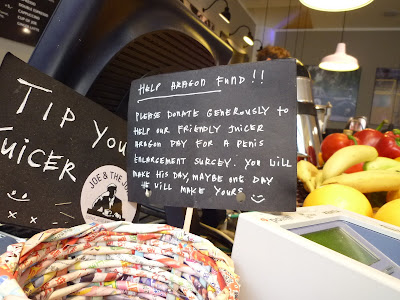
I thought I’d got to know the Danes and their blunt, earthy sense of humour well enough. Apparently not – I was taken aback so much by this sign at the till of one of the ubiquitous ‘Joe and the Juice’ branches in Copenhagen city centre while waiting for my juice, that I had to surreptitiously get my camera out of the handbag quickly to take a shot before Aragon himself (I assumed) turned around with the juice:


The return flight was on the same tiny propeller (seating: two-plus-two rows, twelve of them) that I had flown out with (they look dubious but both flights were the most punctual I’d taken out of London in years). Being the Friday afternoon flight, it was packed to the rafters. There were a family of five sitting around me: the middle-aged parents plus a son of about fifteen in the row in front, two girls slightly older across the aisle. Together they were a picture of the quintessential Scandinavians – tall, blond, blue eyes, with the air of Copenhagen urbanites. Then, just as we were about to take off, they suddenly extended their arms to one another, across the aisle and seats, and held each other’s hands tightly. The pair of sisters stroked one another’s arms up and down for additional comfort and assurance.

I would usually like to think of myself as liberal and racism-free, but frankly if we had been on a transatlantic transporter and them a family of Muslims, I probably would have screamed for attention at this clear display of impending collective martyrdom. As it was, I could only guess that it was a case of genetic fright of flying that could only be assuaged by this peculiar form of physical bonding. As soon as we were safely airborne, the finger-locks were withdrawn and they all slumped back into newspaper-reading and Ipod-hopping, respectively, leaving me wonder what unusual encounters lay ahead in our Moroccan trip, commencing in twelve hours.

Saturday, 20 February 2010

In praise of... The Longevity of Geniuses

My memory of this week has, frustratingly, been defined by the constant battle against a vicious cold/flu (tbc – probably a mixture of both) attack which, as of now, seems to have no end in sight. Year after year, I had hoped to evade the winter germs, but what with daily commute on a variety of public transports combined with a sealed ‘open plan’ office (one of the major blights of modern civilisation), it was doomed to be hope in vain. The only comfort is that colleagues who piously queue up to get their flu jabs each autumn don’t ever seem to manage to prove the potency of the injection at all. I’ve always defiantly opted out of the jabs, so if we’re all getting the same germs anyway, at least I can (somehow) be content with the thought that I don’t have the extra shot of unidentified chemical substance in my system on top of everything else.

Out of a week’s mental state of near-total blur (inevitable, when your nostrils are hopelessly blocked – they are located quite close to the brains after all), two events stand out, and they do have something significant in common. On Tuesday we had Steve Reich back in town, who graciously took his bow again and again after the breathtaking performance of his 1970 classic ‘Drumming’ by the Colin Currie Group at Queen Elizabeth Hall. [Disclaimer: Colin is a dear friend and this article is not going to focus on the concert itself. For totally objective reviews who all heap praises on the performance, check the London broadsheets.] That composition date immediately gives the game away: it was hard to believe that this magical piece was written 40 years ago. The cultural landscape has shifted away – quite a long way away – from the modernist rigours that Reich and his peers were working against at the time. But the work itself has truly passed the test of time, and in each of the three live performances I have heard of it over the last four years (one with Reich and Musicians, two with the CC Group), it was as fresh, mesmerising, challenging and exhilarating as ever – all of these things at the same time. And if the size of the returns queue on Tuesday was anything to go by, I am not alone in being an addict to this music.

But I digressed. I was really going to remark on the Steve Reich conversations that I witnessed that day – one that I was actually a part of (a business meeting discussing programming plans for a major feature of his music next year), and the second was his post-concert talk with Colin on stage. I had to intermittently try to convince myself that we were really talking about those concert plans in the context of his forthcoming 75th birthday (the last big birthday four years ago was celebrated ‘in style’ with festivals in New York, London and elsewhere). Seventy-Five?! Not that long ago, most people would be very happy to live to that age, even in developed countries. But this guy talks and moves about with the sharpness, lucidity, humour, agility and energy that most thirty- year-old guys walking down the street will never possess. At the meeting, I would have happily sat there for hours more to hear him elucidate on Baroque music, African music, DNA, and the atomic bomb, but we had to stop because he had another four meetings to attend to before the evening concert. (And I was still trying desperately to breathe like a normal person.)


As if to prove my point, the other musical celebrity for the thinking man that I encountered, the very next day, was a sprightly octogenarian. It was National Theatre’s Platform event (40 minutes of on-stage interview, followed by Q&A) with Stephen Sondheim, the first of many events to take place in London this year to mark his 80th birthday. This was one of the rare Platform events to be held in Olivier, the largest of the three auditoria in the building, and all eleven hundred seats were packed to the rafters before the talk began. As the great man walked on to the stage, the assembled fans erupted with applause – he got a standing ovation before having even uttered a word! In the next sixty minutes, he gave the most fascinating and thoughtful account of his early days working with Oscar Hammerstein, (briefly) of his formal studies with Milton Babbitt (!), of the working method he used while collaborating with the stellar roll-call: from Hammerstein to Bernstein to Harold Prince. This was, as much as anything else, a chance to hear a living, breathing encyclopaedia of the history of musical theatre recollect the highlights of a half-century’s repertoire, and I was especially heartened to discover that the attentive audience was far from a roomful of grey heads. As with the previous evening’s audience at the Reich concert, it was a rather even spread of ages and genders. The twenty-year-olds seemed to have no less connection to a work like Sunday in The Park with George or Sweeney Todd than their grandparents, and Sondheim answered their questions not with the manner of an elderly statesman, but as a cerebral, witty, genial creator of those timeless works who could easily beat anyone forty years his junior in a debate.

With great creative people like these, you do expect the intelligence to ripe beautifully with old age, but the agility and quick-wittedness that both these guys exuded embody an eternal youthfulness so startlingly, that you have to believe the potency of creative power itself – more than anything that science has come up so far, it gives us the hope of eternal youth. Reich has his composing schedule utterly full for the next few years – the concept of ‘taking a break’ probably shouldn’t exist if you’re perpetually inspired by life itself – and Sondheim coyly revealed at the end of the talk that he had ‘been working on something’ for the last few years which would see the light of day soon. And I remind myself of Louise Bourgeois (89), of Paula Rego (75), of David Lodge (75), of Alan Bennett (76), of Elliott Carter (102) – all of whom are reaching new heights in their respective genre with each new work they give us. If we’re at least able to easily comprehend the senescence that these names are associated with, consider the fact that Stephen Spielberg is 64, Paul McCartney 68, Dustin Hoffman 74 (I know, I was quite startled by this too when I searched online)… The list goes on and on. The lesson seems simple: Create, and Live a Long Youth. In this order.

Friday, 5 February 2010

10 Unforgettable Travel Moments (so far) - Part III

#5: The Moment of (Dream) Childhood Revisited
Disneyland, Paris
August 1999

When we arrived in Disneyland Europe, on Day Four of our great Inter-railing trip, I was twenty-one years old and a bit. A real adult, in other words. Even though I had lived in the UK for two years by this point and had got quite fairly accustomed to the way of life here during this time, the maiden voyage to the Continent – the word immediately implying a vast body of land separate from the snug British Isles, at the other end of which lay my true home – still offered up that unique sense of thrill. And the first three days in Paris had been filled with proper, adult itineraries – the museums, the neighbourhoods, the cafes. I had looked forward to the Disneyland trip as a belated childhood treat, but not anticipated any great excitement about it. Thanks to the ‘reform and opening up’ policy of the Chinese government, my generation – the first single-child generation – had been fed on a TV diet of Mickey Mouse and Donald Duck, though limited to thirty minutes every week, usually on a tiny black-and-white TV screen. The world of Disney was, for the Chinese population of 1980s at large, one of many a gateway that had all of a sudden appeared, to the exciting land that was the materialist, Capitalist Western world. But those of us under twelve, we were utterly oblivious to the ideological significance of those characters at this crucial time in our nation's history. We simply adored them – all voice-dubbed in Chinese – as much as our American counterparts, and the scarcity of their appearance made any virtual encounter with them all the more precious.


We joined the expectant crowd for the daily parade down the central boulevard, and when the ‘magical world of Disney’ soundtrack sprang into life, with the full cast of fantasy characters emerging in their impeccable costumes, my eyes inexplicably welled up (to my great annoyance). In this moment, what had all those years ago existed as the Other, distant, fantastic but alien world, decidedly out of reach except on TV screens, was finally reborn as part of My world. I was there, Minnie Mouse was smiling and waving to me, and this whole surrounding – in 3D, complete with soundtrack – was no longer Myth but a cultural discourse of which I could claim participatory experience, complete with heat and sweat. The dreamland, right there and then, dusted off that dizzying, alluring aura, and entered the diary as just another memorable destination – even for a twenty-one-year-old.


#4: The Moment of Charmed Arrival
Levoca, Slovakia
April 2000

Unlike some of the other off-beat destinations where we’ve left our footprints over the last 12 years, this one hasn’t become the Hot Spot on any Frequent Traveller’s Map, and probably never will be. But this quaint, enchanting little town in north-east Slovakia will forever retain a special place in our hearts, in part thanks to the unexpectedly ‘grand’ hotel where we ended up – well, to be precise, the manager/receptionist who was truly one-of-a-kind.


We had arrived in Levoca station after a creaky train journey from Bratislava, and all the coughing and nose-running I had tried to battle off over the previous two days had chosen this moment to metamorphose into a fully escalating fever. The two uphill miles from the station to the town centre seemed even longer in the rain that was just that little bit too malicious to be called drizzle. The hotel in question, right in the middle of the old town square, was listed in the ‘Top End’ category in the guidebook, and sounded unimaginably lavish by our standard at the time. It turned out to be our only choice by default after the discovery that the other, more budget-friendly option down the road, had closed for good.

Having sign-waved our way through numerous conversations in various small Czech and Slovakian towns by this point, we were startled when the only member of staff on duty opened his mouth with what could only be described as a mock-Basil Fawlty accent. ‘Ah, welcome to Levoca. I trust your stay shall be peaceful’ – meaning, as we discovered thirty seconds later, that we were the only guests in the hotel (and, by deduction, the only tourists mad enough to have come to this part of the world at this time of the year). Then, when being presented our passports – ‘Ah, I believe you are the first Chinese visitors we have ever had here.’ When being quizzed about weather in the following days – ‘I’m afraid the weather is expected to be unfavourable.’ Unfavourable! The last time I had heard anyone utter the word in real life was, well, actually no one ever spoke like that in Newcastle. W’ther’s go’a be shite, more likely. We ended up staying there for three full days and I have wanted to revisit Levoca ever since. To this day, not only was it the only hotel in all our hard-travelling years where a truly elegant suite (with art deco bathroom, complete with free-standing bath) cost fifteen dollars a night, but the memory of such ineffable charm, effortlessly exuded by one single person in the most unexpected place, always brings a smile to my face. These are the moments that make travel addicts out of us.

10 Unforgettable Travel Moments (so far) - Part II

#7: The Moment of Farce (aka The Journey from Hell)
Train journey from London to Manchester
January 2007

This was the Day of The Great Gale. True enough, all the other severe wind conditions before or since, as least as I've experienced in London, have been mere breezes in comparison. But nothing really justifies the way it turned out to be the Day of The Great Farce, as I’m about to tell you now.
This was also the first day of the annual conference of the Association of British Orchestras, this particular year being held in Manchester. Having been accustomed to the vast array of possible reasons obstructing normal operations of any form of British public transport, I wasn't entirely surprised when the 9:35am train I was supposed to embark on was cancelled before departure. It did mean that the passengers from two near-full services would be packed into one, the 10:05am train. I could take this, I thought. But little did I know that that was barely the beginning of what was going to be a very long day indeed.
Five minutes after the train pulled out of Euston station, the announcement came on that due to weather-related speed restriction, the journey would take five hours instead of two and a half. A sea of very un-English groans duly ensued, mostly – rightly – pointing out the absurdity of delaying this news until just after departure. About half the passengers in my carriage commented that they would have opted not to make the journey at all had they known. Well, it seemed that Virgin Trains knew exactly what they were doing – imagine them having to deal with all those refunds if that had been the case.
So we traveled on, at the greatly reduced speed of 55 miles per hour (supposedly – it felt slower). There were intermittent (unannounced, unexplained) stops along the way in between stations, so by the time we ground to a halt completely at Tamworth station, just outside Birmingham, it was well past one o’clock. After a thirty-minute pause, the announcer informed us that we were, well, to be held at the station indefinitely, because a tree had fallen on the tracks some twenty miles ahead and – I’m not making any of this up – ‘a team of engineers were on their way to the site with a view of removal of the said tree’. It was also advised that we got ourselves something to eat and drink at the station, especially as the shop on the train had sold out every last pack of crisps some time ago. I reacted quickly enough to be near the front of the queue at the single tiny shop at the station, where the flustered lady-in-charge was clearly bewildered by the sight of a meandering file of some two hundred customers suddenly materialising in the hope of getting their hands on the five sausage rolls she had for the day (my guess was that she usually had about seventeen customers a day on average). I succeeded, but the one hundred and ninety-seven people behind me had to make do with Maltesers and Mars bars – until they also ran out at customer No. 134, that was.
Back in the carriage, just as I foolishly started to feel smug about the warm sausage roll and the cup of tea I had gulped down, darkness fell – all the lights and, worse, the heating, suddenly went out. We must have, subconsciously, all been preparing ourselves for a very long doomed destiny with this journey, for by the time the next announcement came up ten minutes later it was greeted not by rage or even disbelief, but bemused roaring laughter. The new development was so utterly surreal, it could only be a true-life incident on a British train journey:
‘Ladies and gentleman, you will have noticed that we lost our power about ten minutes ago. I regret to inform you that not only were the engineers who arrived at the site unable to remove the fallen tree, the tree has apparently caught on fire, which has caused the entire West Coast main line to be out of power, and therefore this train – along with all other trains currently stopped between London and Manchester – will not be going anywhere today…’
Was there a happy ending to the story? Perhaps I should have sought a way back to London – geographically it would have made (just a little) more sense, but professional duty propelled me in the other direction, and I ended up in a rental car with two complete strangers, fellow young female professionals who were both returning home to Manchester after a work trip to London. My navigation skills faced the ultimate challenge – and proudly passed the test with flying colours – as we went through a whole maze of small country lanes across Worcestershire, Shropshire, Staffordshire and Cheshire (all the major roads were totally bottle-necked thanks to the weather and the railway fiasco) with nothing more than an old-fashioned road atlas courtesy of the rental company. SatNav? What was that? The three of us quickly bonded over an almost primal urge of taking things into our own hands, especially after all those hours we had spent on the farcical train journey that never ended. By the time I turned up at the conference it was just past 9pm, and the day has henceforth gone down in the memory lane – and to anyone willing to listen to my one hundredth retelling of the story – as ‘my epic eleven-and-a-half-hour journey from London to Manchester. Boy, was I determined to get there or not!’


#6: The Moment of True Community Spirit
Ultra-triathlon, Sado Island, Japan
September 2009

We found out that our weekend in Sado Island – our first-ever visit to this stunning part of the country where most Japanese have not visited – was going to coincide with the famous ultra-triathlon when booking our car ferry journeys. We did it just in time to get the tickets we wanted, but couldn’t help pondering whether one of our only three days on the island would be seriously disrupted by this big event on a small island. The new friends we made on the day before the race waved off our concern with a hearty smile: ‘Don’t worry at all! We’re very laid-back about these here – you’ll see.’ He also confirmed that the race would consist of 9km of swimming, followed by 140km of cycling (circling the entire island), and finally 45km of running. M beamed. I gulped.

The next morning, we took to the coastal road after breakfast, around nine o’clock. The second leg of the race was in full swing, and it was impossible not to be impressed by the gusto with which the cyclists were flying by us, considering they had done more swimming before I even woke up than I had ever done in my life. Our friend was right – there was no major-city marathon-style mania. Everything seemed, in distinctly Japanese manner of course, perfectly in order, with the clockwise side of the costal road reserved for the formidable triatheletes and the counter-clockwise side functioning as usual for us mere mortals shamefully moving about in our four-wheeled vehicles. There were the occasional policemen at major junctions, but mostly to bow their courteous bow and smile their courteous smile at similarly well-behaved motorists, rather than undertaking any ‘police duty’. So were there no cheerers with banners at all then, you ask – that fundamental element to all such events that keep the people going (especially as, let’s face it, the distances involved here are anything but human dimensions)? Well, the London/New York-sized crowds are nowhere to be seen, these toughened human beings perhaps do bristle at the idea of having their families traveling to this remote corner just to cheer them on, and for a short stretch of the road you do wonder if things are not a bit too much on the quiet side. But then you start to notice the locals sitting by the kerb, literally just outside their own front doors. Many were sprightly-looking septuagenians and beyond – Japan is known for its nation-wide longevity, and Sado Island is not a chosen destination of the young by any means. They pop themselves on little hand-made wooden stools, wearing a simple hat to shield the unforgiving sun, and cheer for each and every brave man and woman passing by in a rather quiet, understated manner. Catching these captivating sights at 50mph, I suddenly felt like being placed in an Ozu frame at slightly more modern pace, a beautifully seductive prospect. But then, at approximately five-hundred-meter intervals, there would be a bigger gathering of multi-generational families, usually led by an earnest female in her thirties, lifting – we slowed down especially to ascertain – large bowls of freshly-cut, mouth-watering (we knew because we had stuffed ourselves with them since arrival) local fruits. The pragmatism of taking pick of these seemed at once problematic, but they were a truly delightful sight compared with all the Lucozades that would be on offer instead along Tower Bridge or First Avenue. After all, for every cyclist intent on having a winning place in the race and was hard enough not to be allured by the juice watermelon chunks, there would be four who were grateful that they were there. They did not scrimp on their time so much and would stop for a few seconds and exchange a grateful smile with the ladies, take a much-needed mouthful of vitamin-filled liquid food and nod the emphatic thanks, before charging on. The race was meant to be an international gathering, proved by the dozen or so foreign faces we saw on the return ferry to the main land the next morning (although the universally expired look did not differ by nationality or any other criteria). Yet to me its exceptional charm lay in that easy, local feel. I certainly would never again be able to watch a marathon, live or otherwise, without thinking about those diminutive, smiling elderlies, or the ladies with their heart-warming fruit bowls.

Tuesday, 12 January 2010

Cuban Diaries - Preface

Our Cuban encounter really began in June of last year already, when we found ourselves at what was evidently the most popular event of the ‘Cuba 50’ celebrations at Barbican Centre, to commemorate the 50th anniversary of the revolution. It was a memorable evening, as much for what was on stage as for the audience itself. I had, uncharacteristically, booked the event without much knowledge about any of the acts: an aged, Buena Vista Social Club-esque salsa band, an excellent young jazz trio, and finally, as the main act of the evening, a second half of nueva trova with Pablo Milanes and a small synthe-acoustic band. Judging from the ecstatic response from the Spanish-speaking crowd around us (an exceptional audience demography even for the Barbican, perhaps), we could tell he was a bit of a national icon, a Cuban Elton John of sorts. But then again, the spontaneous mass sing-alongs, which ended up accompanying almost every number he belted out, seemed to contain just a little more than mere passion for the music itself. After all, the guest of honour for the evening had been Madame Guevara, daughter of El Che himself, and the words ‘struggle’, ‘solidarity’, ‘freedom’ had been more than just recurring themes in her impassioned five-minute speech.

There was a certain sense of indefinable, quiet determination in the behaviour of the audience at large, even though the majority of them would presumably have been living in London for a while. They didn’t seem to want to make a big Patriotism manifesto out of the evening (whatever the intention of the event’s organisers had been), and yet the natural, effusive sense of pride, for the achievement of their artists, was acutely palpable and very, very infectious. At the time I was still ignorant of Milanes’s own eventful life story so far, which had included extended persecution by the government because of his homosexuality, ultimately redeemed by officially-endorsed icon status. That fact that he was now firing up the nostalgia of two thousand immigrants – a mixture of legitimate ones and exiles, I could only assume – seemed to carry more than a touch of irony.

The evening fascinated me in so many ways already, and I really, really couldn’t wait for our trip to begin, to see this ‘Land of the Miracles’ (as Steve Smith aptly entitled his beautifully-written book – a must for anyone who wants to know more about the country before visiting it) with our own eyes. If anything, for us it ought to be the Land of Fraternity, for China has supplanted Russia as the main economic benefactor of the nation, ever since the latter stopped its previously generous, crucial aid in the nineties, precipitating the long and bitter ‘special period’. We would again, I thought, stand out among the throngs of Western tourists, as always in the developing countries frequented by more adventurous travellers. But would we be hustled everywhere with non-stop ‘Ni-Hao-Konichiwas’, which inevitably taints one’s memories of even the most beautiful cities? Would we, even worse, be stared at everywhere by the vulture-eyes of expressionless locals who simply regarded us as strange novelties (growing up in China, I always thought this a privilege of the blue-eyed ‘foreigners’, until I inadvertently became one myself, in Burma, in the Middle East, in more remote corners of the US, even)? The only way to find out, of course, is to be there, to go everywhere, to experience – but first of all, to arrive.

Tuesday, 15 December 2009

Alternative Olivier Awards 2009! - a preview

I had the incomparable fortune to sit on the Olivier Awards panel in 2008, which made the whole year of theatre-going experience all the more special. Because they wouldn't take on the same people as lay panellists (which was what I was) in consecutive years, 2009 was a judging-duty-free year in the theatre. However, as I was astounded to have the total number of productions we'll have been to see by the year-end counted by my dutiful partner (sixty-one - including all plays and musicals; eighty-one if you include opera and dance), I thought that perhaps I was adequately qualified to put together an awards list after all. Alas this one will have to depend entirely on my personal taste (eclectic enough, I believe) and judgement (wise enough, I hope). Here we go:-


Best new play

When the Rain Stops Falling, Andrew Bovell
We've had a good year of Bovell plays in London: Toby Frow's new production of Speaking in Tongues shed new light on this earlier work, albeit with an uneven cast; and the European premiere of this stunning new piece, a characteristically multi-layered entangled plot spanning four generations and across two far-apart continents, was a resounding confirmation. Of how a dramatist at the height of his power can judge the narrative and psychological tensions with rare precision, distilling the word 'thriller' with a new, deeper meaning. Also, of the scale of accomplishment by Michael Attenborough in his Artistic Director role at Almeida, one of the independent powerhouses of London theatre. The ensemble cast boast no mega stars yet were uniformly outstanding. The night I was there, Keira Knightley and Rupert Friend were sitting a few rows behind us – now that we know they're both appearing in the West End, it would seem that they were wisely learning from the real pros. It was also one of the very few occasions this year that I was moved to uncontrollable sobs, at any arts event.

Honourable mention: Enron, Lucy Prebble (Royal Court Downstairs); Cock, Mike Bartlett (Royal Court Upstairs)
So much has been said about Enron, all I'd like to add is GO to see it in the West End, if you missed the Royal Court run. It will probably fit the bigger stage a bit better too. I was so pleased we booked for Cock very early on, as it became one of the highlights of the entire year, and because the bare, cock-pit set design (maximum seating: about 60) befit the text so perfectly, it'd be hard to imagine it being transferred to any West-End venue (or anywhere else, for that matter). Here's my 150-word review of it for the Olivier Award panel application:

Mike Barlett's provocatively titled, ninety-minute-long 'Cock', is a compelling piece of work. The series of tableaux portray an emotionally (and sexually – but that's the lesser concern here) confused young urbanite (John, the only named character) oscillating between his long-term male lover (M) and a loving, quietly tenacious female encounter (W), driving everyone involved – including the spectators – into sheer agony with his indecision along the way. If this equivocation sounds like the behaviour of a modern, metrosexual Hamlet, the denouement, a scene of 'the ultimate bitch fight' (as M puts it bitterly) with the threesome plus M's father around dinner table, evokes Ayckbourn at his best. Yet Bartlett shows great promise as an acute observer of contemporary conundrums of the heart, and demonstrates a distinctive style with his spit-fire dialogue in all the two-hander scenes, often delivering piercing poignancy and a great joke in one stroke. Ben Wishaw, as John, leads the superlative cast.


Best musical production
A Little Night Music, Menier Chocolate Factory
It was a shame that the subsequent WE transfer of this superbly elegant revival by Trevor Nunn wasn't much of a hit. Without a superstar billing it really struggled in competing with the likes of Jude Law in Hamlet and Helen Mirren in Phedre, both big summer audience draws. I didn't see it again (at Garrick), nor was I surprised to read about the mostly lukewarm reviews of Catherine Zeta-Jones's return to stage as Desiree in the Broadway transfer a few days ago. The original cast, on the living-room-sized MCF stage, conveyed much more emotional nuance than is usually expected from a musical, even one by Sondheim. The singing was exemplary, the simple design imbued with charm.


Best director
James MacDonald, for Judgement Day (Almeida) and Cock (Royal Court Upstairs)
We've had an exceptional year of London theatre, and yet these two stood out as the most perfect productions of the year for me. The fact that they came from the same director speaks volumes, and yet they couldn't have been more different in idiom and execution. The Horvath revival featured a hugely imaginative and effective use of the Almeida space with its design, which befits the 1930s play about moral responsibilities in its historic details, while also distilling it with a compelling, poetic modernity. Cock, on the other hand, would probably seem on paper like a real headache for many a less able director, with its writer specifying the lack of any set or props. Yet MacDonald achieves that most important task missed (or dismissed, in some cases?) by many directors – he makes us care about the characters, through their primal human behaviours and reactions. The rest is built by our imagination, easily.

Honourable mention: Rupert Goold, for Time and the Conways (Lyttleton, National) and Enron (Royal Court Downstairs)

Enron was the big theatrical event of the year in publicity terms (deservingly so, I hasten to add), but Goold's JB Priestley revival was a revelation of how powerful this 'time play'can still be. With its narrative structure, daringly ahead of its time, and the perpetually familiar setting of a dysfunctional family, the work also features themes of class, mortality, the impact of war, the power of money and the futility of kindness. Phew, quite a heavy-going recipe, you say. Yet above all, what Goold gives us is a poignantly human story, and to me the opinion-splitting multi-media choreography sequences lift the text to a powerfully charged emotional height.

Best actor
Kevin Spacey, Inherit the Wind (Old Vic)
Most pundits have hailed Mark Rylance's turn in Jez Butterworth's Jerusalem as the performance of the year. I beg to differ. Spacey's artistic direction at the Old Vic finally got onto the right track last year, and seems, for the moment, to be going from strength to strength. He's a Big Performer on stage in the same sense as Rylance – powerful deliveries of lines, big physical gestures, sweeping emotions running the whole human gamut. If some of the dramatic movements appear to manoeuvre our emotions, they're there for a reason. Spacey's compelling Darwinian lawyer edges out for me over Rylance's West-country misanthrope, perhaps because so often do powerful plays impress with cool intellectuality stirred and shaken with cynicism, that when a good old fashioned debate (courtroom scene, no less!) fills you with warmth and hopefulness for mankind, it stays in the memory just a little bit longer.

Honourable mention: Ben Whishaw, Cock (Royal Court Upstairs)
I've added it to my Santa's wish list for this year that we see more of Whishaw on London stage before his schedule becomes inevitably monopolised by Hollywood blockbusters and the occasional arthouse films (New Yorkers who're reading this: get a ticket to his turn in 'The Pride' before it sells out NOW – another new play courtesy of Royal Court, this was the winner of the 2008 Olivier Award for an Affiliate Theatre that my fellow panellists and I voted for). It's not everyday that you have a truly dashing leading man who effortlessly exudes indelible charisma as well as piercing intelligence, and when the performer in question is not yet thirty, you know there's a wonderful career ahead waiting to unfold spectacularly.

Best actress
Rachel Weisz, A Streetcar Named Desire (Donmar Warehouse)
I wrote in my pre-review of Streetcar, back in July, that Weisz was excellent in this role but was far too beautiful and youthful for what we expect Blanche Dubois to be. This was echoed by a number of broadsheet critics, and Weisz herself pointed out – rightly – that Williams's text had specified Blanche as being a woman of thirty, a full eight years short of her own actual age. This, if nothing else, is illuminating on how Western society’s perception of youth has changed in the last century. And when I look back on the leading ladies of the year, Weisz's performance still stands out for the integrity and conviction with which she inhabited this well-known character.

Honourable mention: Juliet Stevenson, Duet for One (Almeida)
A superbly understated study of the helplessness of a superb mind, gradually and irreversibly being deprived of the body attached to it. We're accustomed to having such eternally fighting characters on stage now as well as surrounding us in real life. But once in a while an exceptional thespian shows us that the familiar story can be seen through different angles, with a kind of immobile viscerality we hitherto didn't know existed, and that's the case in point here.

Best performance in a supporting role
Bertie Carvel, Rope (Almeida)
Carvel impressed me in the aforementioned Royal Court production of The Pride last year (and as leading man in the new musical 'Parade' before that!), so I'd been looking forward to his latest role, in this Hitchcock adaptation. So much so that I nearly missed his entrance, because the handsome young man I remembered was unrecognisable as the cynical war veteran, so convincingly does he embody the role completely. Now that he's proved himself to be a real chameleon, I think he could become one of the great character actors of his generation. Surely being blessed with good looks doesn't hurt.

Honourable mention: Katherine Parkinson, Cock (Royal Court Upstairs; Rebecca Hall, Winter's Tale and The Cherry Orchard (Old Vic)
Parkinson, along with Ben Whishaw, talks us through a highly charged and deeply confused sex scene (her partner here being a gay man discovering the female species for the first time, literally) with no more physical movement than slowly circling the tiny stage in centrifugal steps. And it's one of the most sensual moments I've ever experienced on any stage. Her diffident, gentle yet steely character is no less complex than others in the play, but is the one who wins our heart. She can do the understated comical too, which is a rare gift.
Hall was memorable in both plays that constituted the inaugural Bridge Project in the summer. It takes a real actress to tackle both Chekov and Shakespeare – her characters effectively divided by twenty years in age – concurrently, with aplomb. As with Wishaw, I sincerely hope her commitment to the stage shall remain for a while, and I can see her maturing into Arkadinda one day already, via Nora and many more Shakespearean heroines along the way.


Best new choreography
Russell Maliphant, AfterLight
One quarter of an evening of world premieres created to the brief 'In the Spirit of Diaghilev', Maliphant's short, mesmerising male solo is deceptively simple by description: a theme and variations of the dancer (Daniel Proietto, ethereally beautiful) spiralling in semi-light. It succeeds, in breathtaking fashion, in what the choreographer set out to do: to capture the essence of Nijinsky the dancer.

Thursday, 26 November 2009

Hail, the Civilised Commute

Well I'd never envisaged these two words appearing in the same sentence - until our blisfully stress-free journey home tonight, after the two-hour-long first half of Mother Courage. (I may be a theatre fanatic but I never waver in deciding to walk out of things, which actually happens a few times a year.) Walking across Hungerford Bridge in anticipation of our usual District/Circle line - DLR journey home, shivering a bit in the newly plummeted temperature, we catch sight of a Thames Clipper drawing near Embankment Pier. I have used the service a couple of times before but always for touristy purposes - specifically, taking visiting friends on a boatride from the Savoy Pier (an easy walk from work) to Canary Wharf, followed by dinner at home. M reminds me that Oyster cards are now valid for discounted journeys on the boat. An unspoken collective decision is made in half a second, as we accelerate our steps descending the bridge. The smiling, laid-back pier staff confirm that the boat is indeed about to depart for the East, and within seconds we are seated in the warm, cavernous cabin, watching the pier recede.

There's really nothing more civilised than taking a boat trip down the Thames at ten o'clock on a winter evening. The early Christmas lights already seem a bit more plentiful on the Southbank than usual, offsetting the slightly more distant, yet no less imposing sight of the Parliament nicely. The water is calm, and the brief stops at each pier along the way - only if there's anyone alighting or waiting to board - so smooth, that the harsh chill and wind that we enountered a few minutes ago already seem like a strange urban myth. The National that we just stepped out of, Oxo Tower, Design Museum, HMS Belfast, Tower Bridge - all the familiar landmarks that we choose to sweep under the 'sights for tourists' category on overground journeys anytime of the day, now seem to disclose themselves in a tantalising new dimension. I'm sure the gently irregular, undulating rhythm in which we're travelling has something to do with it. All around us, the dozen or so fellow passengers are either solo commuters (some people caught this boat a lot earlier than we did - metaphorically of course) buried in their books or Blackberries (for you can actually do all the virtual business here if you want, unlike on the Tube), or couples exchanging muted conversations. This naturally serene, almost poetic setting discourages high volume of any sort by default.

Before we know it, the glowing Canary Wharf towers are upon us. We disembark the boat with a cheery wave to the boat staff (even the people working on the river are so much nicer than their underground colleagues), commencing the short walk home. At just over a pound more than the regular Tube journey would have cost, this was worth every penny. We resolve to ascertain the timetable of the Thame Clipper service in the post-theatre hours, and I suspect we'll soon become regulars on the boat. Post-culture journey home had never felt so perfectly civilised.

Monday, 23 November 2009

10 Unforgettable Travel Moments (so far) - Part I

As you'll see, some of these are longer journeys rather than moments per se, but let's not get too academic here with the definition. All of the experiences made the list for a variety of wildly different reasons...

#10: The Moment of Disbelief

national highway, Eastern Syria (near Iraqi border)
April 2009
We've been exploring nearly half of the country by this point, both the more touristy route between Damascus and Palmyra, and the areas beyond, which distinctly less so. We've got used to the reckless locals suddenly appearing out of nowhere in the rear mirror, in their battered vehicles, overtaking us in a flash, and disappearing in the distance in similar Formula-One fashion. The Roman blood apparently still runs deep in many Syrian veins, a whole Millenium later, when it comes to driving. However, this relatively wound-less Kia (most new-ish cars gracing the roads in this country are Korean makers, including our rental car) has just done something very odd indeed: having overtaken us with no hesitation at all and already in a lead of about 500 meters, it suddenly slows down in the neighbouring lane - or something that's supposed to be such - as if waiting for us to reciprocate the triumphant gesture. We keep to our speed and catch up with it in a few seconds, and realise that we've become the object of this bizarre scrutiny-in-motion: the three local youths in the Kia have evidently never before seen two Asian tourists venturing into this part of the country in their own vehicle, and want to make sure that we're not some weird mirage that they dreamed up at high speed. Once they've ascertained that we really resemble normal human beings, albeit scoring even higher on the scale of recklessness perhaps, they step down on the gas once again and disappear into the horizon. You'll never believe how fast a ten-year-old Kia can possibly go until you've taken a trip along the Eupherates.

#9: The Moment of Natural Power

Prof Leider's house, near Miami, Florida
January 2006
Prof Leider was one of my PhD colleagues at Princeton, and the last time we saw each other was in early 2002. We're therefore doubly thrilled to be invited to this roast-pig party on New Year's Day at his new family abode, just under an hour's drive from Miami. The neighbourhood is your typical suburban Florida (or so as I perceive it): sprawling one-storey family homes, thus hurricane-proof, each with surrounding lawns and/or woodlands roughly the size of two or three postcodes in London. As we pull up the Leiders' driveway, the first sight that greets us is, um, a free-standing, seemingly fully-functioning, fully-loaded Pepsi machine. Our dear friend comes out the front door. 'Welcome you guys, so great to see you!' 'Yes wonderful to see you too but, listen, what on earth is this doing in your front lawn?!?!'
He grins and recounts the story for the five hundredth time. They had the annual hurricane season a couple of months ago, which in this part of the world is taken for granted as just a slightly more inconvenient part of your life. One of the more severe ones lasted about two days this time, and after it ended the Man of the House pulled up all the customary window boards and went out to inspect the damages. The first thing he sees, lying right outside their doorstep, is the Pepsi machine. He puts it up against the wall, finds a power socket and plug it in - for this is what you do when you see a Pepsi machine, right? - and lo and behold, the whole thing pops back into life instantly, complete with backlights. They now have a fully-loaded, fully-functioning Pepsi machine to entertain the two little children with. Of course, being the conscentious and intelligent people they are, they manage to track down the provenance of the machine, which in fact belonged to a school two towns away, pre-hurricane. Professor rings the school up informing them of this latest chapter in the adventure of the machine, but it would seem to be the final chapter, as the cheerful lady at the other end of the line asks him to keep it, for their brand-new replacement has already arrived courtesy of the super-efficient hurricant insurance company. This is the brief but bizzare tale of how two visitors from London end up spending part of their New Year's Day celebration inserting pairs of quarter coins into the Pepsi machine proudly guarding Prof Leider's front door, and receiving the can in the slot below with a loud Thud!, in amazement.

#8: The Moment of Pain

Midnight in Business Hotel Room, Stockholm
October 2006
I'm in my favourite city for a three-day business trip to attend multiple concerts featuring music by one of our most important composers as well as numerous meetings, and have happily settled down at the central hotel that I'm already familiar with from previous stays. Three in the morning, I suddenly wake up with the semi-conscious awareness that something is wrong. It takes another two seconds to realise that what's wrong is that I'm in excruciating pain, and yet another two and a half to locate the precise source of this pain - in my lower gums, where I had a filling done two years previously by a young dentist who I thought looked a bit haphazard at the time, and whom I now just want to strangle with what little strength there is left in me. The rest of the night is sheer agony - it doens't just hurt when you try to chew something on that side, but all the time, when you talk, when you think, when you try to think, every waking and sleeping minute. I stick to the original meeting schedule for the next two days while managing the minimum intake of food and drink that keeps me alive. I go to the dentist's (not the same one!) the moment I get back to London and a root canal is scheduled for the next day. Two lessons learned:
- Don't ever take anything for granted when it comes to the dental department. Nothing's ever wrong until something goes horribly wrong.
- The threshold of physical pain endurance is as high or as low as you can let it be.

Sunday, 22 November 2009

Old friend, New friend, Non-friend

I can't help thinking how Sex-and-The-City-like this blog title is, which would be appropriate, as I made a mental note to write about it after being greeted - for about the two hundredth time - shrilly, earnestly, a little too worryingly fervently -

'How're ya doing' today???!!!!'

Yes, I was in New York City a few weeks ago. And no, I had no personal or professional connection with the person who'd just flashed an ear-to-ear smile at me with the question, in fact I didn't know him/her whatsoever. I had, as you've probably guessed, just walked into a shop for a spot of aimless window-shopping, but my new-found oldest friend was determined not to let even the slightest impression of neglect take hold.

Many frequent travellers, myself included, would acknowledge the commendable enthusiasm of the service-industry employees in the US on the whole , compared with their European counterparts. They like to make you feel they really care, their actual knowledge or competence being an entirely different matter. The big smiles and fully-loaded attentiveness are supposed to be the norm. And even an awful cynic like me can be left impressed often. But after all these years - including two living in the US - the intimacy of the Big Greeting by a total stranger can still make me jump sometimes. Or just simply wonder: do they actually ever expect a truthful reply to the question (for that's what it is, however rhetotic)? What would happen if anyone actually looked into their eyes and replied with equal fervour: 'Well, I'm feeling really crappy. I had a horrible day at work and things aren't going so well at home either. And now a total stranger has just pretended that they genuinely care about how I feel. I mean, I've given you the honest answer and now what can you do for me?!'

Globalisation and technology have, hand in hand, changed our perspectives on relationship and intimacy in so many ways. But really there's no point in deluding ourselves. In the world of Facebook, you become 'friends' with people who you've met once or twice. Didn't it use to take a little more effort, serendipity, common interest - and, simply, time - for true friendship to take hold? Whatever happened to the category of 'acquaintances'? What's wrong with just being acquainted with someone? Well nothing, except that if A is an Acquaintance to B as opposed to a Friend like C is, there's something horrifyingly wrong with A, especially if all this Profile is viewed by three hundred other people on a daly basis.

I am indeed aware that the meaningless enquiry of our state of wellbeing is not specifically confined to the American retail sector. Doctors, helpline workers, telemarketers, total strangers in any other number of guises, all want to know just how you're feeling right this moment. And of course no answer other than the positive affirmative can possibly be comtemplated. This is the basic rule of manners of our social existence. But because we already live in a world of excessive spam - materialistic, virtual, emotional - it's quite refreshing, once in a while, to be greeted by something that's merely functional but really a lot more useful than an empty smile. The shop assistants also automatically pump out their chorus of a one-liner in Japan and China, and they tend to be:

'Please feel free to look around!'

A Superb Korean Trio

By design rather than coincidence, we've had a bit of a Blitz of Korean cinematic outings in the capital lately. First there were the strong selections at London Film Festival, then the Bong Joon Ho retrospective (at NFT) and the annual Korean Film Festival at Barbican ran almost concurrently. We managed to catch quite a few recent releases amidst it all, and these three really stood out.

Mother - Bong Joon Ho's latest, it's the best of both worlds of his two previous films: the who-dun-it Memories of Murder with a skilfully woven plot that would satisfy the most hard-core detective story nerds; and The Host, with the disguise of a monster disaster movie but really is about the complexity and frailty of human relations, especially those between family members. At the opening of the film, we see the mother of the title chopping up dry herbs on a machinery terrifying in its simplicity. We can already foresee the consequence of her action because she is wholly distracted by the movements of her son, cursed with mental disability (the source of which is itself revealed in a particularly chilling moment later in the film), across the street. Yet she's oblivious of it, because what happens and what will happen to the boy is all that matters to her. This single-minded determination accompanies her on her dark journey throughout the film to discover the truth behind the terrible murder that her son has been implicated in. Yet the revelation of every piece of new information, the peeling away of every layer of the onion skin, involves the inevitable, and sometimes fatal, baring of the soul. By the end we're just as much in need of an artifical injetion as the mother herself, to ease us from the pain brought on by the acceptance of our innate, helpless callousness. I can imagine scores of Hollywood directors looking at the script over and over again before giving up on a potential adaptation, because there's no way of making a new version of this one without preserving the poignant ending. The mother has already shown us how her own, and the son's, destinies are sealed with those semi-automatic fallings of the dry-herb gullotin. There can be no nother way.

Scandal Makers - written by the debut director Kang Hyeon-Cheol himself, this is a superb comedy that achieves the almost impossible - making a roomful of Western and Asian audiences roar with laughter for the same reasons. The protagonist of the film is the host of a hugely popular phone-in radio show, a sleek confirmed bachelor in his mid-thirties. The opening sequence is almost a parodied version of the famous 'daily morning ritual' scene from American Psycho, with the eligible single male in his designer bachelor's pad, going through the motions of muscle-building exercise, skincare journey in the power shower, outfit deliberation in the walk-in wardrobe, and nutrition-specific breakfast. His show has been doing particularly well of late, with millions tuning in to follow the gripping story, serialised by emails, of a young single mum in the quest of her own father, who lost his virginity at the age of fifteen to an older woman, and is not aware of the existenc of his offsprings at all. The host charmingly urges her to seek out her destiny, except little does he know this will lead to a knock on his own door at a most inopportune moment... The basics of the story may be far-fetched but are never contrived, and the human reactions by each characters, to the unlikely situations they find themselves in, are hilarious yet touching. Stereotypes and cliches pop up from time to time, but all in good will, and you never feel for a moment that the writer/director is deploying a gag just to create gratuitous laughter. The totally dedicated cast rise up to the challenge, and I defy even the most unflappable cinemagoer not to swoon each time the five-year-old Wang Seok-Hyun (playing the grandson) appears on screen. Highly recommended. Catch it before the inevitable Hollywod remake hits the screen (reportedly already in the works).

A Frozen Flower - you would be forgiven for thinking that it's nigh-on impossible for any other film-maker to try treading the water again with a tangled story of homosexual love involving royalties in the court of ancient Korea, after the sumptuous The King and The Clown from 2005. Well, the director Yu Ha pulls it off with admirable panache, complete with - gulp - even more stunning lead actors. One of the key differences in the plot device from the earlier film is in the female character. The Queen here, instead of being just a jealous, passive aggressor, is one third of the male-female love triangle. The King is also not a tempestuous, ignorant tyranny, but someone who's intelligent and righteous, whose priority in a life-threatening moment is to ensure the safety of his queen, even though he has not spared a sparkle of love for her, either emotionally or physically. Such graciousness is only maintained, alas, until the moment he realises that the Queen has supplanted him in the heart of his true love, the dashing Captain of the Royal Guards who has been groomed by the King since childhood. And who sowed the seeds of the discovery of heterosexual carnal thrill but the King himself, in a desperate attempt to produce a royal heir under the covers ('You're the only one I can trust', he says to the Captain, an ominous key of a sentence, to the Pandora's box for all concerned). All three lead actors imbue their characters with both striking nobility and touching vulnerability even in the most delicate situations, of which there are numerous, running the whole emotional gamut from the farcical to the heartrending. Against the epic backdrop of sovereign battles, royal assassinations and other age-old political games, the director presents us with the simple question of Where the Heart Lies. And even after all the blood is shed, the hearts broken, the skulls brandished (literally), the answer is still appropriately ambiguous. The court scenes at banquets, army inspections and assassinations serve up a visual feast while never losing the meticulous emotional details, which is something that films such as Zhang Yimou's Curse of the Yellow Flowers utterly failed to achieve in contrast.

Monday, 16 November 2009

Michael Haneke, The White Ribbon

The ancient Chinese adage goes: 'The beginnings of all human beings consist of nothing but kindness.' Well do they really? Haneke's latest masterpiece confronts us, head on, with both sides of the argument. All the adults in the film, including the narrator, the school teacher (an atypically uncomplicated Haneke character), merely provide background layers - albeit crucial ones - to the story. Whereas the group of children, aged four to fourteen, are the focal points of the stark blank-and-white (literally) canvas.

Haneke is well known for pushing his actors beyond the usual limits of performative capacies, yet what superman techniques he deployed here to extract such chillingly heartfelt (for one's heart is over-chilled throughout most of the scenes) performances from these little ones, only the devil knows. For the devil hides himself in every unseen corner, and eventually manages to creep into some of the veins of the underaged beings. Or was he there all along? Every adult playing a noble (in social terms at least) role in life has an appallingly dark side here, and the way they attempt to preserve the 'purity' of their offsprings is via emotional humiliation, physical abuse, religious shock tactics, or all of the above. The oppressed include not just these children, but when their adult company make an attempt at retaliation, the outcome is clumsy and futile, only to bring more severe punishment onto themselves. The children, in contrast, are much more instinctive and ruthless with their acts of evil, and what initial fear there might be it quickly subsides - once the fascination with death is brushed aside, there is nothing left to fear. Respectable adults busy themselves with adultery, incest, religious hypocrisy, deceipt, class resentment, familial despotism (a rather short list for a Haneke film, really). How pathetically banal. The invisible ones - for they are purposefully overlooked, until our ardent school teacher decides to really look around - carry out the horrific acts as if saying, Look what you can really do if you go straight to the core. And we're all alike. We were all born like this, not consisting of an ounce of kindness. The so-called child-like innocence was always a facade after all. We're just waiting to become adults so that we will have proper excuses to web schemes and layers for our brutalities, and then we can instill all that into our own children too, all in good time.

The fact that these children would grow up to be the Nazi generation has been pointed out by every film critic worthy of his job, but to me it's almost an afterthought. The abrupt ending to the village horrors, as everyone, adult and child alike, is distracted by the onset of WWI, could almost be replaced by the onslaught of any arbitrary war, without the specific historic reference. The really vital context of the story is not that particular annus horibilis of human history, but the human nature itself. For our children's innocence had been tainted not just by these parents, but by generations of forbears already. When did it all start, and where will it end? In an even more atypical Hakane scene, l'auteur depicts an almost completely care-free, happy moment between prim, shy, ingenuous young lovers. Not a message of hope amidst despair exactly, but a provocatively tender masterstroke nevertheless.

Wednesday, 4 November 2009

What I Believe In

Because we're destined to be ordinary people
We owe it to ourselves
to live extra-ordinary lives

Sunday, 11 October 2009

Ten Days in October

[optional subtitle: 'Finally we've realised why we never manage to do all the laundry...']


1 October, Thursday.

Philharmonia Orchestra concert, Royal Festival Hall
It's always a treat to hear Janacek's mindblowing Sinfonietta, and the RFH is probably the only London venue fit for the piece. I shouldn't be lavishing Magnus Lindberg's chorus-and-orchestra piece Graffiti with praise due to conflict of interest, but for me, it really revealed itself as a substantial addition to the repertoire, especially with the splendid choir (Philharmonia Voices) in this performance. I had heard the piece at its world premiere back in May, in Helsinki, and this second hearing eally helped to confirm my faith in it. If only more contemporary orchestral works could be blessed with repeat performances similarly in quick succession, by different but equally devoted interpreters - can't wait to hear the third commissioner (Oslo Philharmonic) tackle the piece, alas it's going to be 18 months away.


2 October, Friday

Judgement Day, Almeida Theatre
A five-star production in all aspects for me. Christopher Hampton's beautifful translation of the Horvath play keeps that most crucial element - the ambivalence of morality - exquisitely poignant throughout. The ensemble cast is uniformally powerful yet subtle, with Joseph Millson the devastatingly effective leading man. Why isn't this guy more famous? I sure hope every casting director who knows their business came to see this and that he lands a big starry role on stage somewhere soon, before we lose him to the screen. Special praise also goes to the set and lighting designers - this was probably the most daring transformation to the Almeida set-up I had seen for as long as I can remember, and it packs a punch.


3 October, Saturday

Le Grand Macabre, English National Opera
I knew from the curtain rise that I was going to like this production immensely. ENO's director-led programming strategy has has its hits and misfires, but this one firmly belongs to the first category. Everthing that happens to the naked giantess that dominates the stage, literally, dramaturgically, musically, anatomically - made me shudder. Ligeti's score, as a whole, actually convinced me less than I'd expected, despite the wonderful playing from the pit. But all in all this was an outstanding achievement by everyone involved. A lot of the straight-faced operagoers manifestly hated it, some politely baffled by it, but sure enough no one was going to forget it in a hurry.


4 October, Sunday

District 9
So this is what a mock-documentary, quasi-arthouse, humanitarian/existential/Sci-Fi/racial morality tale in the shape of a sleeper hit looks like. The only thing that displeased me about it was the rendition of the ending, which was an undisguised act of paving the way for sequel(s) to come.Those Big Blockbusters offering simpler versions of the plot usually try their mightiest to restore your faith in humankind, this one shatters it ruthlessly - or does it? See it and decide for yourself.


Another, more notable event of the day: our first-ever attempt at making seafood risotto, a joint operation, ended up a resounding success. The whole thing was gone in a matter of minutes.


5 October, Monday

Enron, Royal Court
Everything those five-star reviews say about this is true. No wonder there was already a queue of about 20 people waiting for returns when I collected my tickets 2 hours before the show started (such irrational tenacity never fail to amaze me - why would you join a returns queue at a sold-out show if there're already more than 15 people in front of you?!). Rupert Goold and his team clearly knew from the beginning that their show was destined for West End and Broadway, for this was conceived as a blockbuster show of the smartest kind, multi-media theatre par excellence. The changes he made to the script (which is still in pre-rehearsal form in the published version) all make perfect sense, tightening up the dramaturgy considerably. Sam West's central performance as Jeff Skilling deserves at least a nominatin for every acting award going this year, and the young, energetic ensemble tackle their many fantastically choreographed scenes (never will you think of the trading floor in the same way again) with total panache.


6 October, Tuesday

Cloudgate Dance Company, Barbican Theatre
If you turned up expecting dazzling contemporary dance, you'd leave disappointed. If you changed your mindset and decided to take it all in as an 80-minute piece of performance art as devised by one of China's most interesting visual artists working today (Cai 'Olympics Firework Architect' Guoqiang), you could end up reasonably gratified. I say 'reasonably' because with this length the poetry is diffused (as is our attention), and although there were undeniably breathtaking moments, in the end the piece as a whole seriously lacked coherence. Still, the final moment, which really delivers the impossible and sucks you in relentlessly (yes, I mean it), was worth spending the evening with this troupe.


7 October, Wednesday

Alas, a night in (early train tomorrow morning to Brussels)! Repeated the same risotto recipe with the same satifying result. Now firmly a new addition to the repertoire.


8 October, Thursday

Guangzhou Symphony Orchestra concert, Palais de Beaux-arts, Brussels
This was the opening concert of the Europalia-China festival hosted by the capital of the EU. If you happen to be in town, or have the chance to go, anytime in the next two months, it's well worth checking out the festival programme, which features an impressive line-up of artists for what is essentially a government-led diplomatic event. I was also pleasantly surprised to discover that the Margrittte Museum next to the Palais had just opened its shining doors, after being shrouded in a giant Margritte-esque building facade for the last couple of years. Even though I didn't get a chance to go in on this trip, it's certainly been added to my long list of reasons for returning to this (still highly underrated) city for a personal visit as soon as possible.


9 October, Friday

Life is a Dream, Donmar Warehouse
How rare it is these days to see a major institution (for that is what the Donmar is, for me) taking the Spanish Golden Age really seriously, and it probably would have faulted in a production any less dazzling than this one (literally - the bare back wall of the stage is gilded with golden splashes which later metaphorphoses into a vertical pool of blood). Legions of The Wire fans can drool about Dominic West for all they like, for me this performance - utterly frightening with uncontrolable rage one minute, vulnerable with nuanced confusion the next - showcases a very fine stage talent indeed. For once, the big TV-name casting for the sake of box office allure is justified. Some would say the material is merely second-rate Shakespeare from a lower latitude, and in places the long monologues do drag a bit, but the fine actors here (Kate Fleetwood, aka Mrs Rupert Goold, is the worthy equal of West with her dramatic arias as well as her depth and gravitas) give us a consistently gripping evening, and even the ludicrous all's-well-that-ends-well finale can be forgvien with a smile. Additional marks to the haunting music provided by Dominic Haslam (complete with muscles, in the 'cage').


10 October, Saturday

Inherit the Wind, The Old Vic
There are two things you need to know about this: one, when someone like Trevor Nunn who applies the broad-stroke brilliance he's known for (this is the man who brought Les Mis to life, after all - he really hasn't needed any work for the last 30 years on account of this royalty bill alone) to something that might otherwise looks a bit on the dull side on paper, it works. And two, Kevin Spacey gives his most memorable Old Vic outing yet (I don't want to think of this as 'the culmination' - more to come, please!), and his is a tornado of a performance, eclipsing a remarkable David Troughton and various supporting acts. We've all seen the American courtroom face-off scene in films that we can all rattle off for a good few minutes, but this is infinitey more gripping, intelligent, funny, complex and humane - all these things in turn.


"And on the morning of the eleventh day, we decided -"

- that we really needed a nice, big dose of visual arts. Turning up at Tate Britain 20 minutes after opening time on a Sunday morning to find the Turner and the Masters exhibition already crowded was uplifting (we aren't the only freaks!) and dispiriting (I'd hoped to see this in a much emptier setting!) in almost equal measure. Some of the aesthetic parallels theorised, between Turner and the sources of his inspirations seemed a little too academic/arbitrary, whereas the comparisons of his later works with his contemporaries were more fascinating to this viewer. While we usually conjure up those mesmerising seascapes as the main association with Turner's name ('Atmosphere is my style', apparently the man declared), it was particularly interesting to discover his forays into portraiture, and to conclude that some of those attempts were a bit clumsy. Later, in the courtyard of the Royal Academy, we couldn't help wearing the smug smile of the RA member while walking past the substantial queue (limited timed entries, no doubt) for the Anish Kapoor show. The word 'retrospective' is utterly inappropriate and irrelevant here, for the centrepieces are tailor-made for the space, and even pieces that weren't, such as Yellow, looks like it was always destined to be on that side of the wall. Breathtaking, thought-provoking, dizzying (literally, in one of the rooms).

Thursday, 6 August 2009

Thoughts on Flights II - What is Haute Cuisine?

23 May 2009. VS 238. LHR-HKG

I've just started my first in-flight meal on this thirteen-hour flight. If only plane food actually is presented as it sounds – alas, not in the twenty-first century. The 'menus' could look and sound terribly fancy, and yet each and every item on the tray just manages to contain that bit of awkwardness that you do wish they'd given you something quite plain but more pleasing than, say, yellow-brown green beans boiled two days ago and now 'dressed up'. As if the prospect of being bound to the half-foot space for the next half-day isn't depressing enough already, I suddenly realise that I've made one of the worst mistakes you can make when having an economy-class in-flight meal - I've chosen a programme called 'Yi-Pin Ryoyi' on the V! Japan channel on the entertainment system (sure, the food sucks but I still stick to Mr Branson's airline where I can, mostly for their entertainment programmes).

Yi-pin ryoyi means, literally, 'first-class cooking'. Any producer of the equivalent of such programme in the English-speaking world would have named it 'Haute Cuisine' (with just enough English accent in the pronunciation to ensure the snootiness of it). And what would this be in the heart of Tokyo, which is consistently featured in the global chart of cities with the highest living costs? Since Japanese food (I mean the real deal – perish any thoughts of Wagamama!) worldwide is already synonymous with freshness, exquisiteness, tastiness as well as nutritional values, you'd be excused for thinking, as I did, that it would be the Tokyo version of Gordon Ramsay/The Ivy/Nobu. But that couldn't be further from what's presented next.

Yu Café, located in the beautiful, historic neighbourhood of Ueno, is famed for its 'bi-hu shituro'. That's beef stew to you and me. And actually, that's the only dish they offer, day after day after day, all year long, . 'They' consist of a total staff number of two, a mother-and-son team. The mother, who must be in her fifties but has such impeccably beautiful skin common among Japanese women, looks like she could be in her late thirties. She brought up the son (now in his late twenties/early thirties?) all by herself, remarkably while remaining a career woman, working in publishing. A few years ago they opened up the café together in the front room of their own 75-year-old house, and since then it's become, if the crowd of lunchtime customers captured on screen is anything to go by, a real hit. They take us through their daily routine – the son takes their two dogs walking, picking up all the cooking ingredients (fresh beef, miscellaneous vegetables) he needs en route from local shops. Meanwhile mum cleans up the space and gets ready for cooking. The secret of the beef stew is in the stock apparently, and even though I didn't understand a thing being said, they clearly didn't give out the secret here. Each order of the stew is beautifully presented in a little stone pot, topped with freshly steamed vegetables, and served with bread and salad. It may sound utterly un-Japanese, yet the visual aspect of it – how you can tell the beef would be tender and juicy and delicious just by looking at it – already beats a lot of dishes that sound much more pretentious and are much less tempting. The customers, who include local businessmen as well as tourists, can't get enough of it. One of them is a heavily-accented, middle-aged man-in-suit from Osaka, who could have come all the way on the bullet train for a bowl of the stew for all I know. And there's just something intrinsically satisfying about the fact that everyone's eating exactly the same thing and in agreement with each other on their high opinion of the food. If only real socialism could be achieved thus! Oh, and the cost of the set? A total of 1000 yen (approximately US$10). No wonder the cute female presenter keeps widening her big eyes, with non-stop exclamations of 'Soo nan desu-ka!' (Is that so!)

Next up is a Ten-don place, in the heart of Ginza, where real estate prices rank among the highest in the world. Ten-don is short for 'tempura-don', don being the generic dish of bowl-of-rice with topping, which is just tempura in this establishment. And yes, you've guessed it – they serve nothing else but this signature dish, and if your tempura encounters so far have mainly/only involved greasy batters with a barely recognisable soggy centre, just watching this would make you a complete tempura convert (well, as well as making you feel so awful, about not being able to actually have it right here and now, that it hurts – trust me). Again – one can only accept that the Japanese haute cuisine is routinely borne out of such circumstances – it's a family business through-and-through, in this case a husband-and-wife team in their fifties. The words 'forty-one years' appears in the subtitle when he describes the history of the restaurant, and I guess it's been a family business for at least a couple of generations. The whole process of tempura being created here is captivating to watch from start to finish. First he selects three huge, plump shrimps whose freshness manifests itself abundantly. They're dipped in a special batter before being fried in sesame oil at 180C – the chef here does a hand gesture to stress the importance of the precision of this temperature. There's some magic working here, for when they're lifted from the fryer a couple of minutes later there's no residue oil dripping at all, almost a physical impossibility. Next up is assorted vegetables – again, unlike the bog-standard line-up of carrots and sweet potatoes we tend to get, they use carefully selected asparagus, aubergine and other indigenous Japanese varieties. In the meantime, the other half of the don – the rice base – is being made by the Madame of the house. Whereas usually this would be just plain steamed rice, not so at an Yipin-ryori restaurant! She lightly fries sliced onion with beaten eggs, using a minimal dollop of oil, which acts as a sub-topping, the scrumptious, soft layer between rice and the crown jewels of tempura. The whole appetising bowl is then served with miso soup and pickles. At this point the lovely presenter reveals yet another house secret – the chef conjures up a whole line of miso pastes from under the counter, each originating from a Japanese prefecture, from which he chooses and serves each customer depending on their accent – 'so that they can have a taste of home' (or at least that's what I think he said). And the pretty lady – if she weren't obviously so nice I'd have really, really hated her by now for the privilege of devouring all this – now lightly sprinkles green tea salt – I couldn't have made this up if I tried – all over the tempura, then everything is devoured, in a matter of seconds, with a lot of 'umms' and 'ahhhs' (well, their Japanese equivalent). Again, local workers and visitors alike don't seem able to get enough of this place, and the sight of impeccably-besuited bankers patiently waiting in line in this little side alleyway amidst all the surrounding Ginza grandeur is something to behold. Yet the most memorable frame is the humble smile of the proprietor/chef and his simple motto: 'Beautiful food makes you want to smile, I guess that's why I've enjoyed doing this for so long.' Oh, and the most important piece of information – the heft costly of all this 'ji-pin' (the ultimate food) as pronounced by our presenter? 1200 yen for the set, that's US$12. Those shrewd bankers sure know how to get the best value out of their hard-earned money.

If you think my enthusiasm about all this is completely disproportionate, and probably due to exceptionally bad accompanying meal thanks to Virgin Atlantic, think again. I didn't even understand what was being said on the programme 98% of the time, and just about managed to piece together all the practical information with the aid of the Japanese subtitles, some of which were in Chinese characters (as with all written Japanese). I'm simply struck – as I have in the past, time and again – by how differently the Japanese define 'high quality' as Westerners mostly do nowadays. Even in Tokyo, the most expensive city in the world, haute cuisine needn't cost the earth, quite the opposite in fact. The things they believe in, and celebrate as a people, are what make their food so unique. Sure, there are places all over the country where you can find thousand-pound-bottles of champagne, Phillip Starck interiors, set menus that can take a lengthy ritual to finish and cost a small mortgage to consume, and establishments where 'tipping' (although in the discreet Japanese manner) is a euphemism for 'be prepared to leave half of your savings account here'. But they choose not to show any of those exclusive and elusive options as their places of joy and pride, instead giving us a perfect and illuminating lesson of what haute cuisine means to them with these two little gems of examples. And for me, there is an upside to having this on the in-flight system after all: by the time I've watched this for the fourth time, Hong Kong is not that far away.